What Percent Of Mobile Users Download An App
Ever wonder what drives someone to use (or not use) a mobile app?
Or what blazon of mobile app they're probable to use the virtually?
Or how much fourth dimension they're spending in the mobile apps they download?
Skillful news…
In this postal service, we've gathered 28 of the most up-to-date mobile app usage and download stats, facts and projections yous can use to make sure your own app aligns with what your target audience is actually doing in 2021 and beyond.
We've pulled research from the likes of App Annie, Statista, Sensor Tower, Mary Meeker and more to bring you the numbers and insights that thing about.
Let'due south get right to information technology (or skip to a section below).
Mobile App Usage & Download Statistics
Millennials & Gen Z App Usage Statistics
Mobile App Revenue Statistics
Mobile App Usage & Download Statistics
We kicking things off with stats nigh usage trends and download habits. These numbers highlight what's going on in the mobile app market today and even speak to the psychology of mobile users.
1. Mobile internet usage is rising while desktop net usage continues to fall. (Mary Meeker)
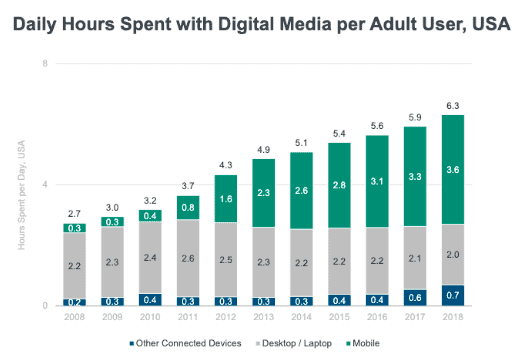
According to the 2019 Mary Meeker report, the number of hours spent on the net continues to increment every year, but the split betwixt desktop and mobile is becoming more and more pronounced. In 2018, Americans were spending 3.half-dozen hours per day on mobile (12 times more than a decade prior) and just 2 hours per day on a desktop or laptop (which has stayed pretty consequent since 2008).
2. Nearly 90% of mobile internet fourth dimension is spent in apps. ( eMarketer )
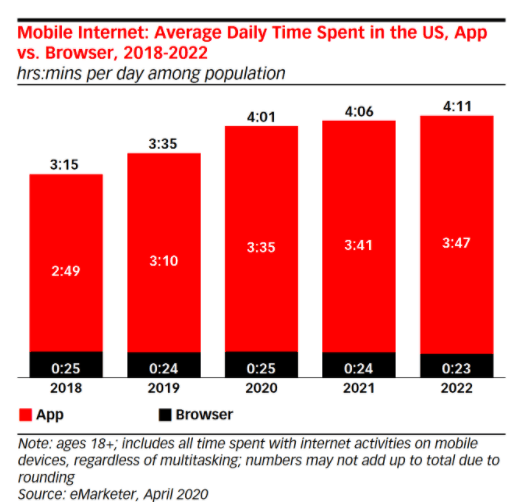
The gap betwixt mobile app usage and mobile browser usage is also widening. In 2020, eMarketer predicts that adult smartphone users will spend about four hours per twenty-four hours using mobile internet, and 88% of that time will be spent in mobile apps, rather than a browser. This speaks to the importance of companies not only optimizing their websites for mobile, but creating custom, responsive apps too.
3. In that location are currently more than 2.nine million apps available in the Google Play Store. ( Statista )
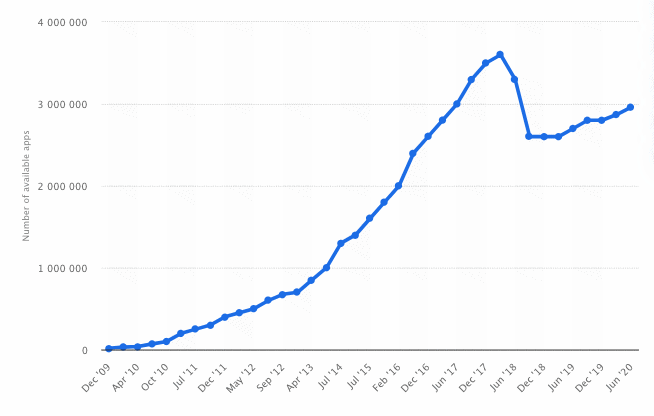
As of June 2020, at that place were 2.96 meg apps published in the Google Play Store. While the Android operating organization leads the pack for market share globally, it's interesting to larn that competition is much lighter here than in the Apple App Store (come across next statistic).
4. There are almost 4.iv 1000000 apps available in the Apple App Store. ( Statista )
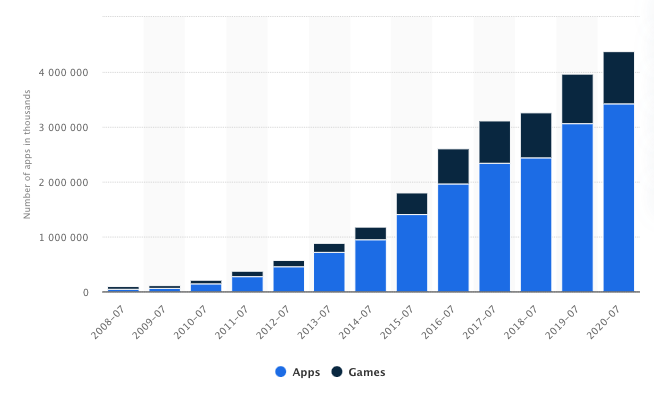
As of July 2020, there were 4.37 million apps published in the Apple App Store. According to Statista, there is i gaming app available on iOS for every four non-gaming apps.
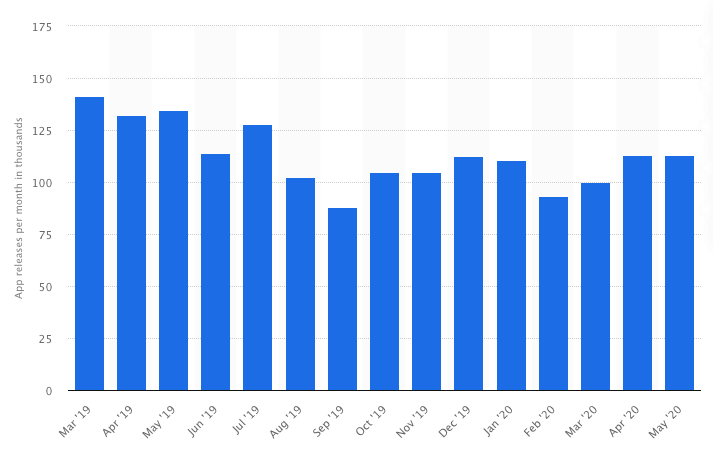
five. On average, more than 100,000 new Android apps are released in the Google Play Store every month. ( Statista )
While there are fewer Android apps live on the market today, new Android apps are beingness published at a rate iii times greater than iOS apps (run into side by side stat), with more than 100,000 new apps being released each calendar month.
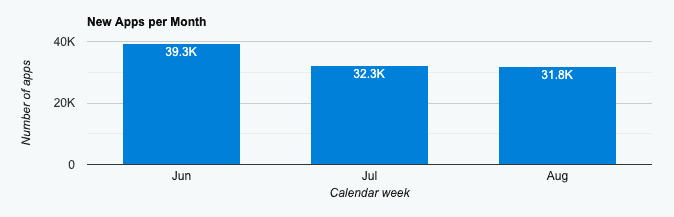
6. On average, more than than 30,000 new iOS apps are released in the Apple App Store every month. ( 42Matters )
New iOS apps are launched at a slower rate than Android apps; this may exist due to the Google Play Store reportedly existence cheaper and easier to enter—and, as mentioned above, there are far more Android users than iOS users in the world. Sometimes it makes more sense to cater to the numbers, only not always. We often meet businesses choosing to build for both platforms.
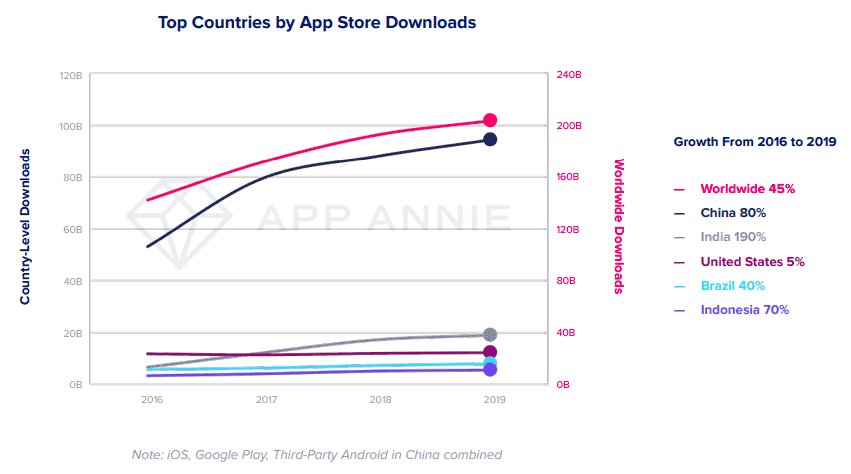
seven. Consumers downloaded 204 billion apps in 2019—and that number continues to climb. ( App Annie )
The number of mobile app downloads each year has been steadily increasing. In 2019, in that location were 204 billion app downloads worldwide (excluding re-installs and app updates). As App Annie reports, this is a 45% increment from 2016.
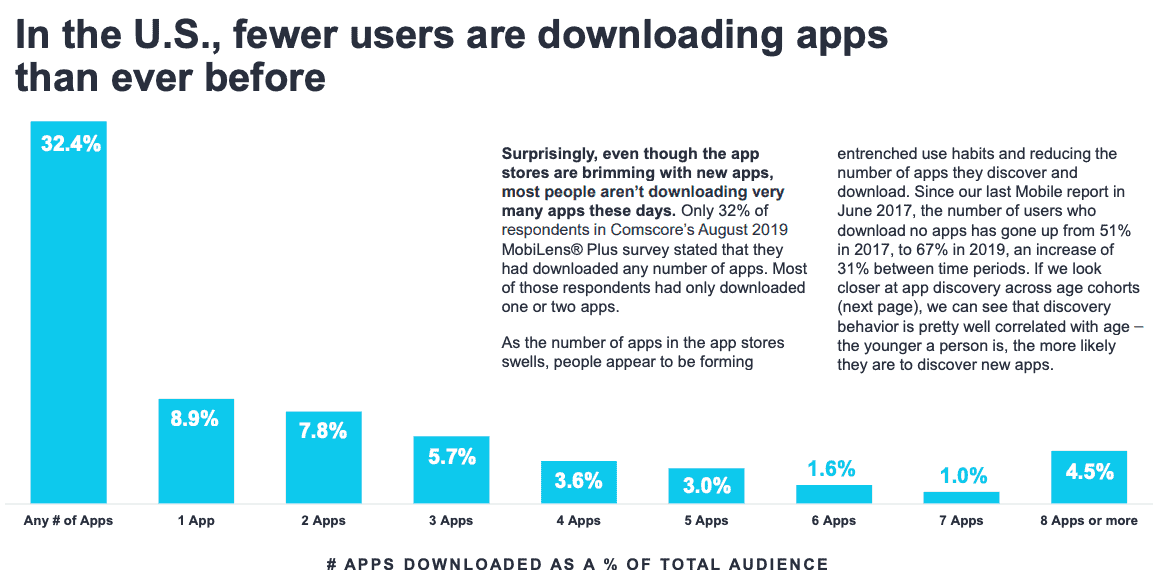
8. The average number of apps existence downloaded in the U.S. is decreasing. (Comscore)
Though global download growth and the amount of time spent in mobile apps are both steadily rising, download growth in the Us is levelling off (as shown by App Annie information above). A report by Comscore further supports this trend: In one quarter of 2109, 2-thirds of smartphone users in the U.S. said they downloaded an boilerplate of 0 new apps per month. The takeaway here is that unless you're Google, you shouldn't brand an app but to make an app. Getting a user to adopt a new app or switch from a competitor is non easy—yous've got to give them a reason to go to the app store and make that download.
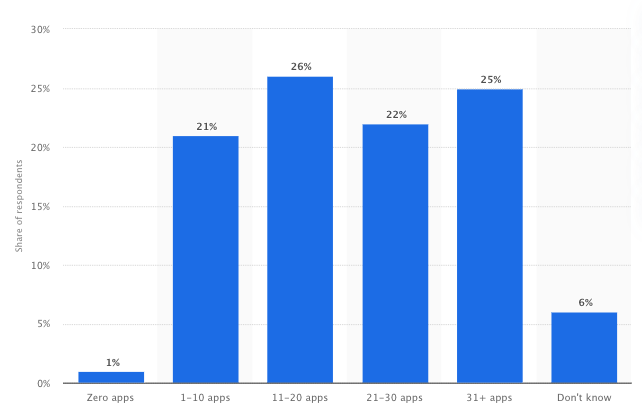
nine. Most users take more than 10 apps installed on their phones. ( Statista )
In a survey conducted toward the end of 2019, nearly three-fourths of respondents said that they accept at least 11 apps downloaded on their phones (not including pre-installed apps). So while new apps are not downloaded very oft, the average user withal has a decent number of apps already vying for their attention. Downloads, nonetheless, are a pretty weak metric for success. If a user is not consistently opening and using your app, it's substantially merely there collecting dust and is at loftier gamble of being deleted (see next stat).
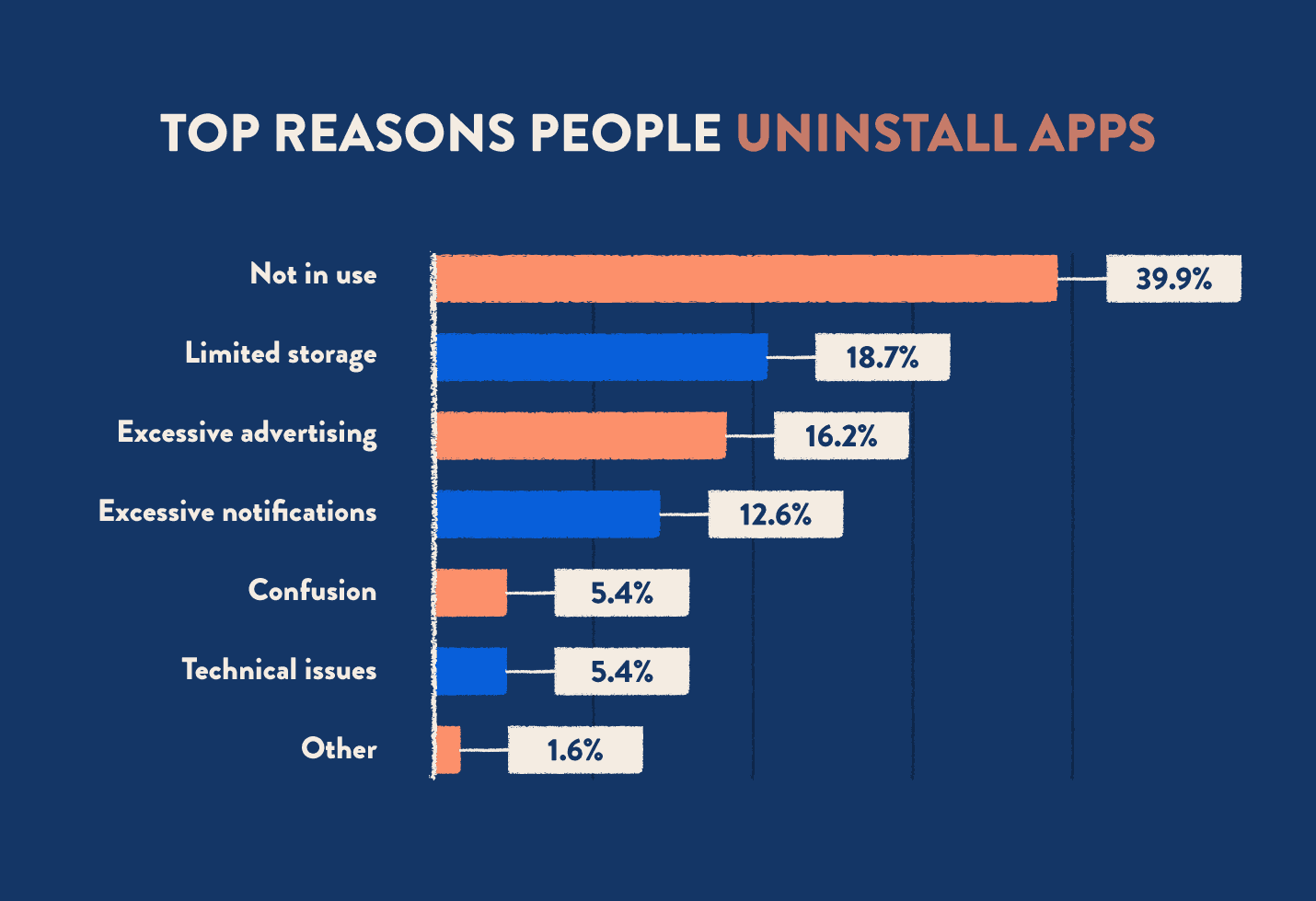
10. The number 1 reason people uninstall apps is because they aren't in use. ( CleverTap )
How often do you purge your phone of previously installed mobile apps? Many users do, primarily because those apps are not being used. The reason they aren't beingness used, though, is what businesses need to focus on. Among the other top reasons for uninstalling: not plenty space on their phone, excessive advertising, and excessive notifications. As CleverTap points out, all of these responses speak to 1 matter: a poor user experience . Functionality is everything, and poor UX tin can guarantee the failure of your app.
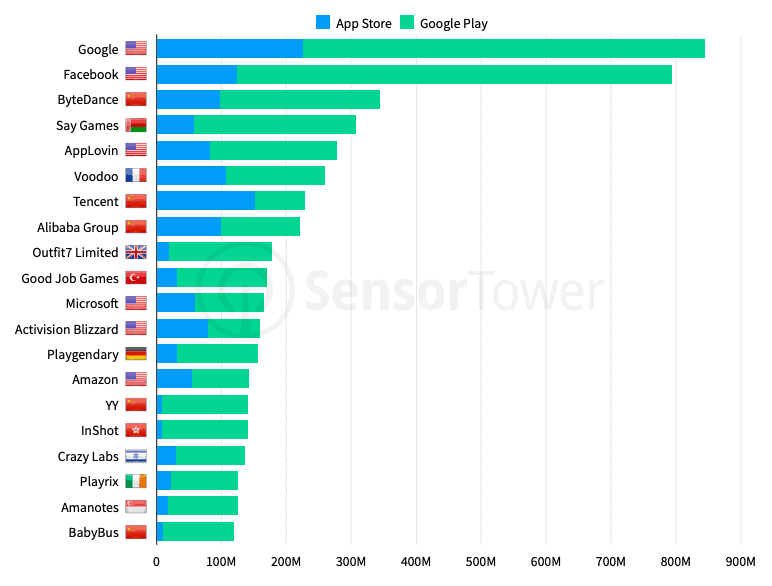
11. Google owns the majority of the mobile apps on the market today. ( Sensor Tower )
With apps like Maps, Hangouts and YouTube, Google LLC owns the majority of apps published in both the Google Play Store and the Apple App Store. Google is creating apps to improve the experience of users and strengthen their connectedness to the brand . Information technology's a keen business organisation motility, and you don't take to be Alphabet to do it.
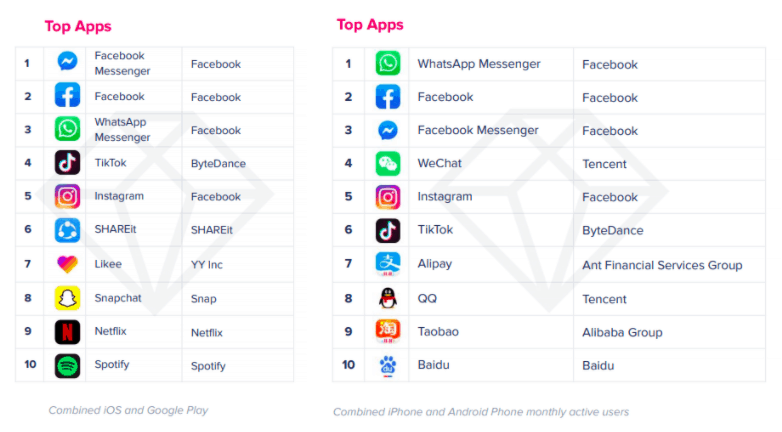
12. Facebook Messenger is the top mobile app worldwide past download, and WhatsApp is the acme mobile app worldwide by monthly active users. ( App Annie )
Google may own the most apps on the market, merely Facebook ultimately wins with 4 out of the v most downloaded and most used apps. Also interesting to notation is that all the apps in the pinnacle 5 are social or communication apps. This aligns with findings virtually the most popular app categories (more on that below).
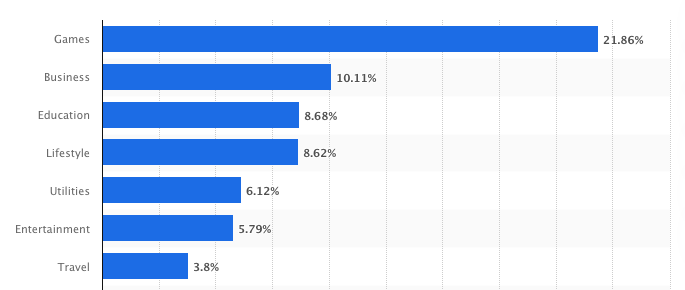
thirteen. More 20% of all mobile apps in the Apple App Shop are game apps—2X the number of business apps. ( Statista )
Of all the mobile apps in the Apple tree App Store, the most popular category for developers is gaming apps. Near 25% of all mobile apps fall into the games category. That's two times more than than the second highest category, business organisation. If you lot're looking to launch a new gaming app, be prepared for some tough competition—but also be prepared to ride the wave of a massively booming industry !
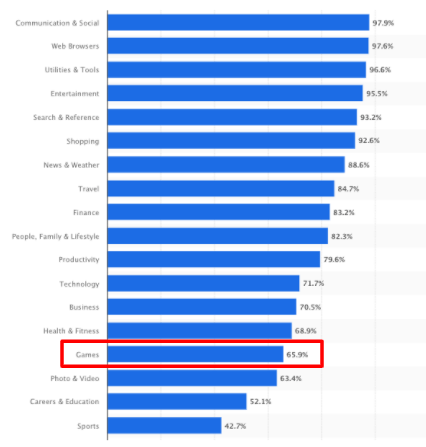
14. Only 66% of smartphone users take game apps on their phones. (Statista)
Although gaming apps are the nearly commonly created, only 66% of smartphone users have at to the lowest degree one gaming app on their device. In contrast, more than 95% of all smartphone users have a communication or social app, spider web browser, utility or tool app, and entertainment app. Statista does not specify whether or non pre-installed apps are included in their data.
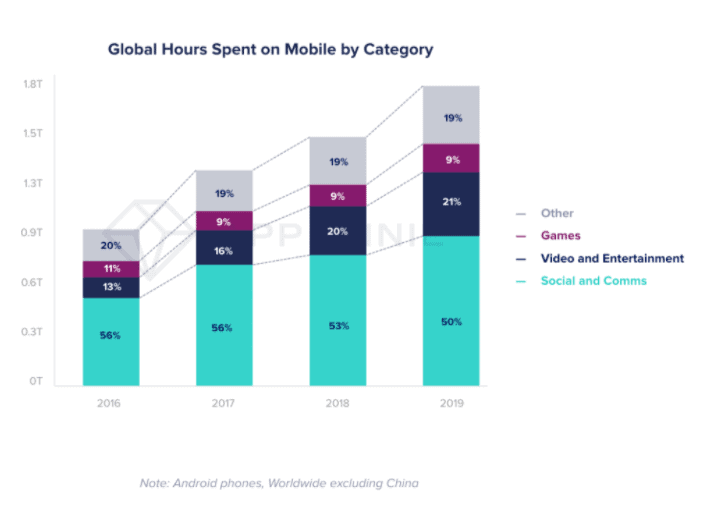
15. Smartphone users spend 50% of their mobile app time in social and communications apps. ( App Annie )
Non only are social apps the most frequently downloaded, but they are also where smartphone users are spending the biggest chunk of their time (50% of total usage time, to be verbal). In second place are video and amusement apps, like Netflix and TikTok, coming in at 21% of full usage fourth dimension. As App Annie reports, the lines are beginning to blur betwixt social apps and entertainment apps as new generations plow to them for like purposes.
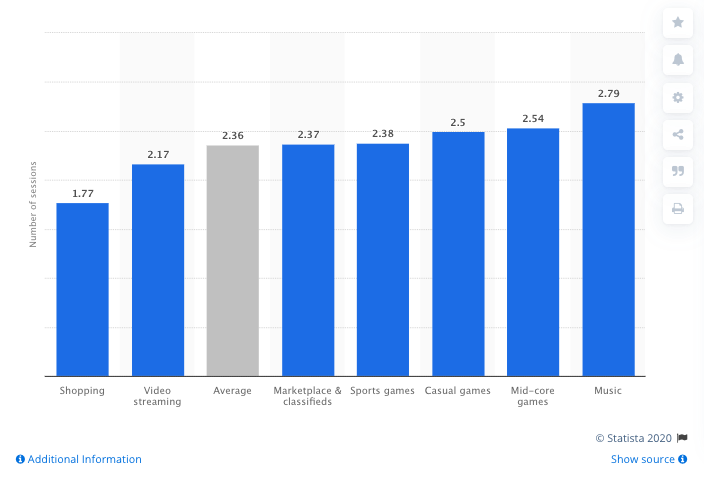
16. Music apps are launched more daily than any other category of app. ( Statista )
While users spend most of their time in social and communications apps, they frequent their music apps more than any other app blazon—launching them nearly 3 times per day, on average. This is a little hard to believe, considering how oftentimes users seem to log into Facebook, Instagram, their texting apps, and even email, on a daily footing. We'd expect to see the social and communications app category somewhere on this chart, and since information technology's not, it's difficult to fully empathize this data.
Millennials & Gen Z App Usage Statistics
Millennials and gen Z are the ii most tech-savvy generations with rapidly growing purchasing ability . If your app targets these groups, understanding what makes them tick will assist you persuade them to adopt your app.
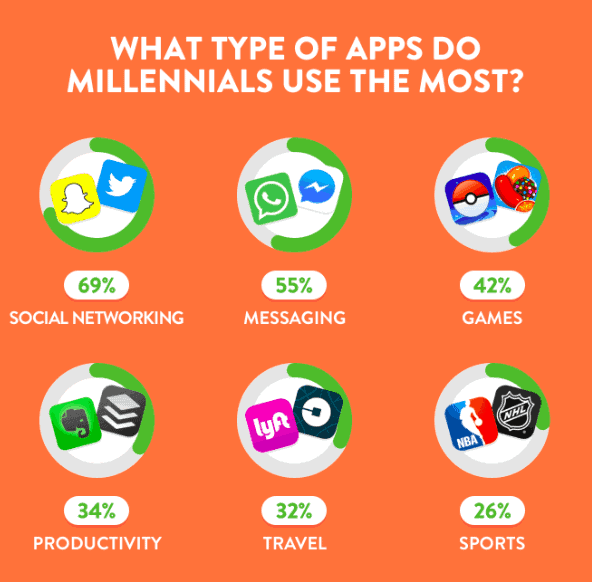
17. Nearly 70% of millennials say social networking apps are among their most commonly used. (MindSea)
Among millennials in particular, the number who listing social media apps as their most often used category is at 69%. In second place, at 55%, is messaging apps—because again, the most popular utilise of apps is connecting and communicating with others. If y'all're targeting this generation, consider incorporating features in your app that allow users to connect with their peers and be part of a community.
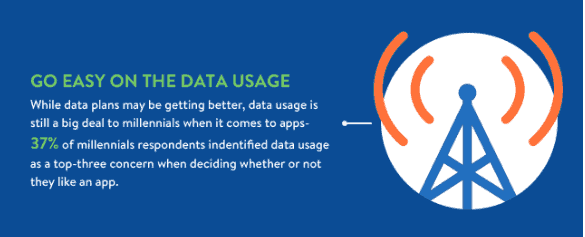
18. Roughly 37% of millennials list data usage equally a key factor when deciding if they similar a mobile app. ( MindSea )
When asked about the top factors when deciding if they'll go along a mobile app, 37% of millennials said excessive data usage was a dealbreaker for them. A perfect example of this is Pokémon Become—when it start launched, the app quickly became a viral striking, but users were constantly frustrated with how much data it ate up, and many deleted it. As you're edifice your ain mobile app, keep in mind that high data usage may result in users hitting the delete button fast.
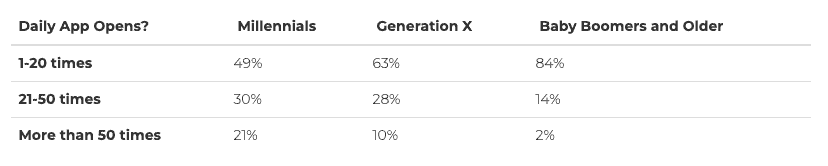
19. 21% of millennials say they open their apps more than fifty times per day. ( The Manifest )
On a daily footing, millennials open up their mobile apps more than than any generation prior. Are yous i of them? It'south nearly noon and I've already opened 4 social apps, 3 communication apps, a weather app, my email app and the calculator app—and many of them take been opened more once. It's not that difficult to get to 50! Younger generations today are tech savvy and always on their phones. Build a great app, build their trust and loyalty, and they will come up dorsum time and again.
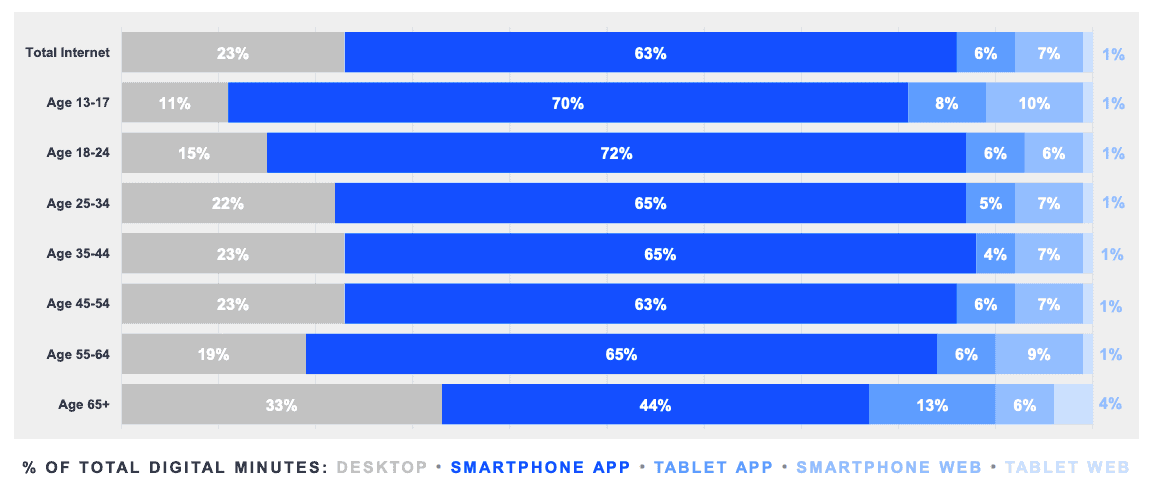
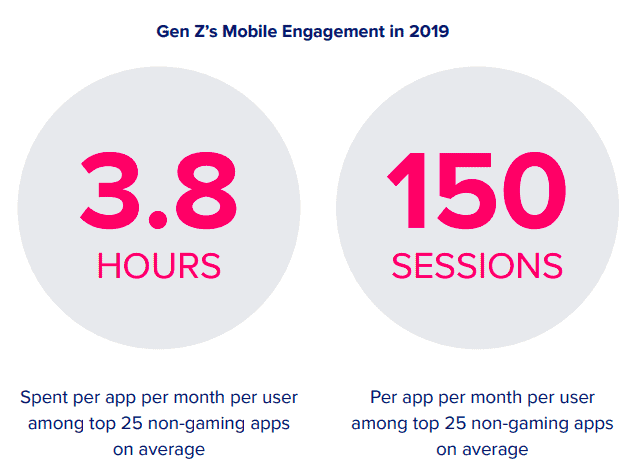
20. Gen Z spends 71% of their digital media time using smartphone apps. ( ComScore )
As ComScore points out, smartphone users betwixt the ages of 13 and 24 are the heaviest mobile app users. This is supported past App Annie data , which shows that gen Z holds the crown for total number of sessions and full time spent per month in top, not-gaming mobile apps. As App Annie as well points out, gen Z is set to soon surpass millennials as the largest generation, and so if your target audition falls in this age group, this is good news for you.
Mobile App Revenue Statistics
Lastly, we round out this slice with some insights on mobile app revenue. If you're looking to monetize your app, here's what you need to know…
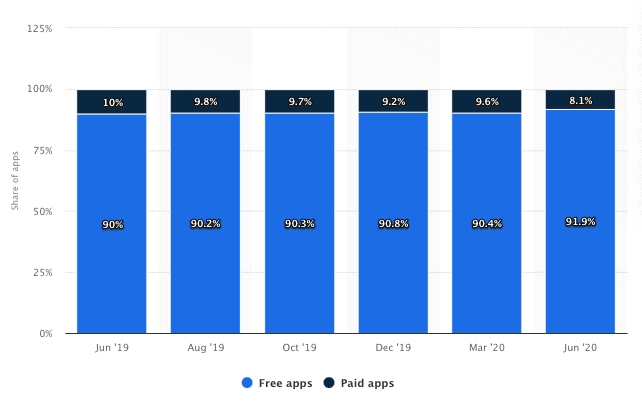
21. 92% of apps in the Apple App Shop are costless. ( Statista )
Free apps dominate the market place. Amid app pricing strategies , the complimentary and freemium models appear to be the ones that have consistently worked the best across app categories, given their increasing popularity. Many of these apps still making coin thanks to ads, add-ons and upgrades.
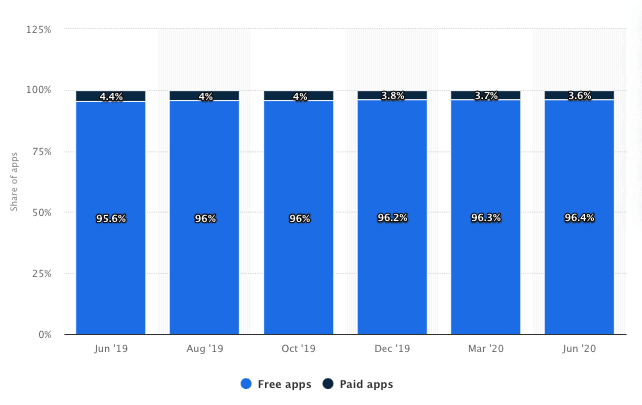
22. 96% of apps in the Google Play Store are complimentary. ( Statista )
The majority of apps in the Google Play shop are likewise free, and a higher per centum than those in the App Store.
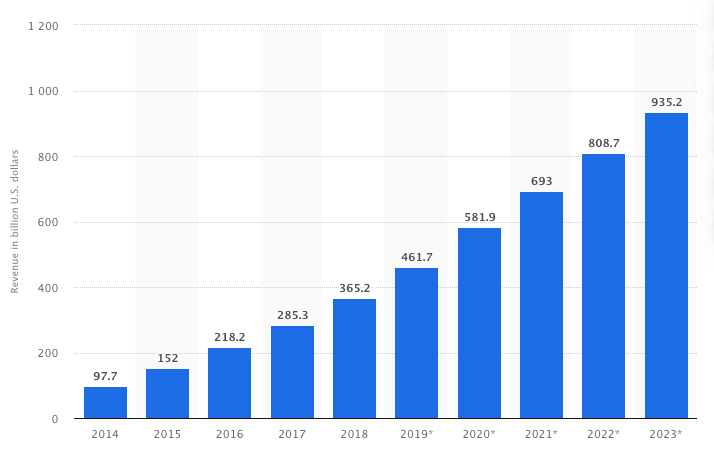
23. Mobile apps are projected to hit $581.9 billion in revenue in 2020. ( Statista )
In example y'all had whatever doubts, the mobile app market is hot. App acquirement has risen tremendously over the past decade; this growth is forecasted to continue, with revenue projected to striking nearly $ane trillion in 2023. It'southward not too tardily to get in on the action !
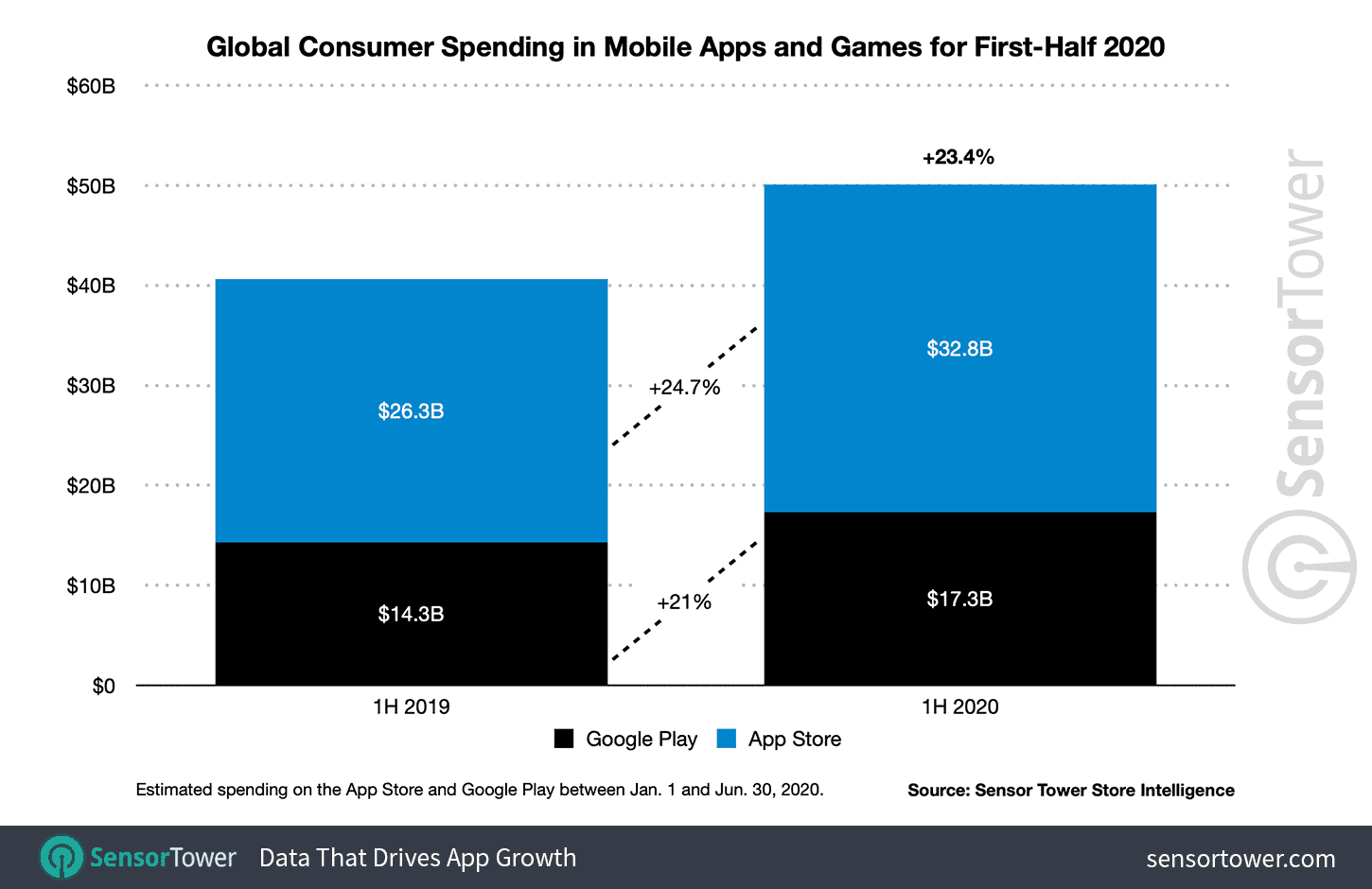
24. Apps in the Apple App Store bring in nearly double the acquirement of those in the Google Play Store. ( Sensor Tower )
If maximizing acquirement is a priority for your mobile app, you may want to launch in the Apple App Store. Sensor Tower reports that iOS apps consistently bring in more than money than Android apps. Remember, at that place are virtually ii times the amount of apps in the App Stores and ane fifth of those are gaming apps. These figures are probable contributing to Apple tree's leg up in the acquirement department.
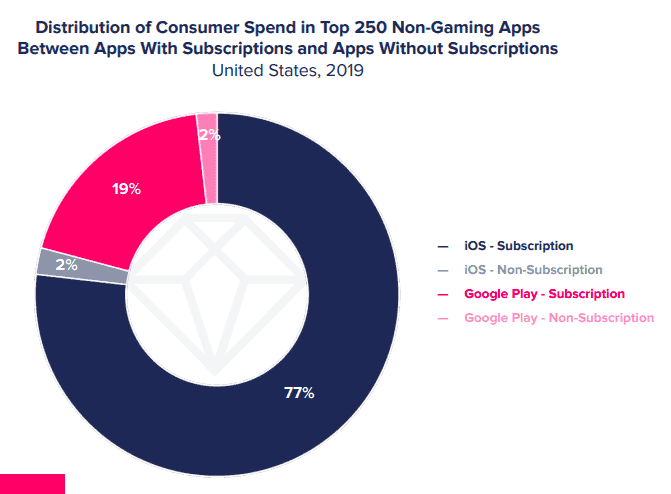
25. Apps with subscriptions account for the majority of consumer spend in pinnacle non-gaming apps. ( App Annie )
In the U.S., subscriptions contribute the most to growing mobile acquirement numbers. App Annie reports that in 2019, 97% of consumer spend in the top 250 non-gaming apps in the Apple App Store was driven by subscriptions. In the Google Play Store, subscription-based acquirement came in at 91%.
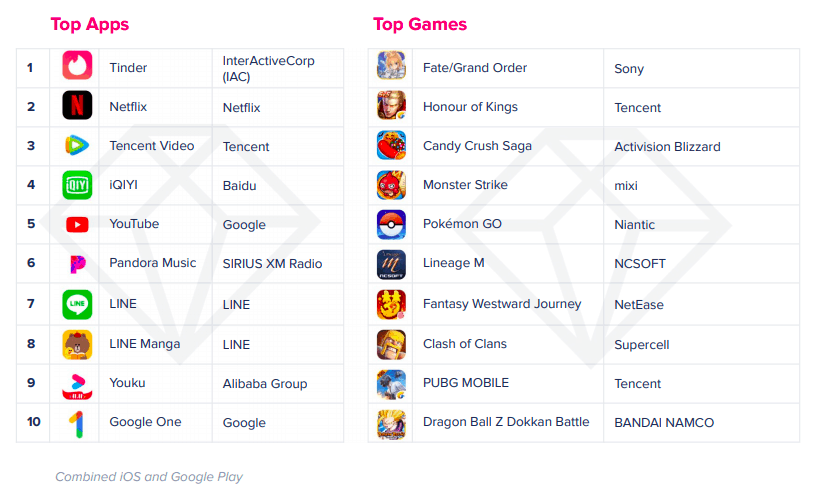
26. Consumers spend the most on video apps. ( App Annie )
Iv out of the top five non-gaming apps for 2019 based on worldwide consumer spend were video apps. Video has been a growing content format for years at present, and it's not going away. It is also a popular type of content for subscriptions, then video apps drive a big clamper of mobile revenue. The fact is, in and outside of apps, video content is rise in use and popularity across industries; including some elements of audio, video and or animations in your app wouldn't be a bad idea.
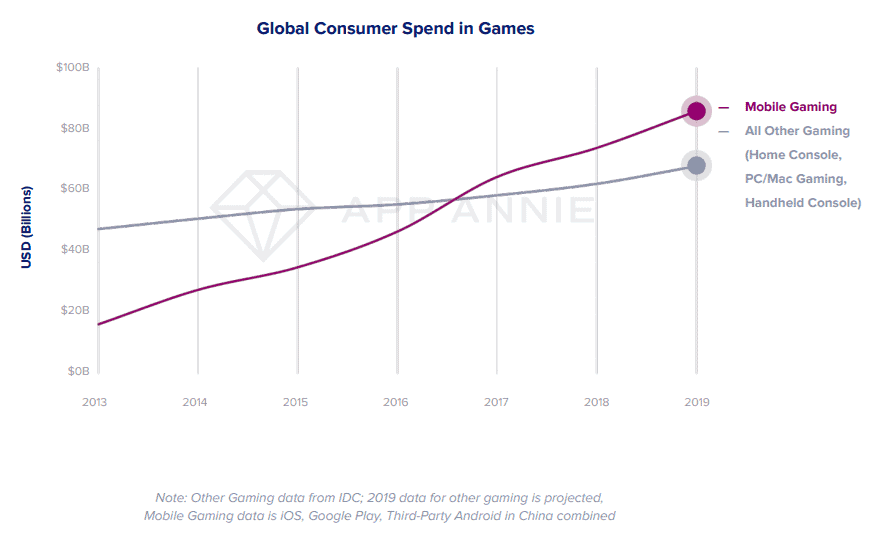
27. Mobile gaming is projected to surpass $100 billion in consumer spend in 2020. ( App Annie )
The year that mobile gaming took off… Co-ordinate to App Annie data, in 2019 consumers spent 25% more on mobile games than all other gaming combined. Spend was projected to surpass $100 billion in 2020, simply that number may end up even higher now with the boosted heave mobile gaming has received from stay-at-domicile orders. You can read more well-nigh the impact of COVID-19 on gaming in App Annie'south 2020 gaming spotlight review .
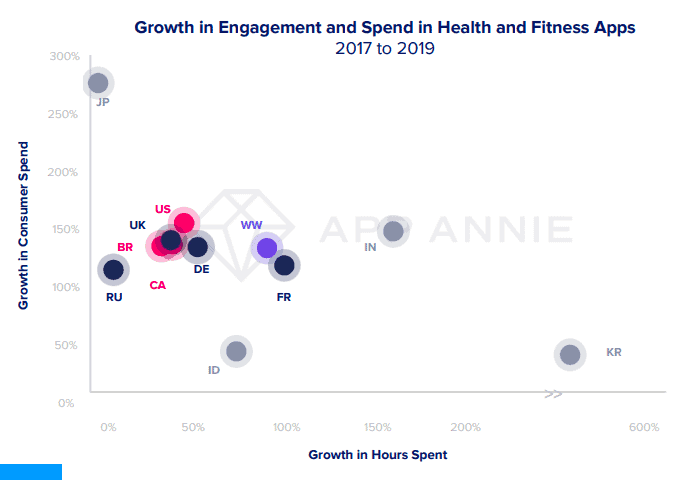
28. Consumers spent 130% more in health and fettle apps in 2019 than they did in 2017. ( App Annie )
Exercising is another at-home action that more consumers have been exploring since the pandemic forced the closure of gyms, sporting fields and rec centres. According to Sensor Belfry, health and fettle app downloads are up 47% yr-over-year , and per App Annie, consumer spend terminal year was already up 130% from 2017. That's correct: In 2019, consumers worldwide spent a total of $1.v billion in this category, so if health and wellness is the marketplace y'all're in, at present is the time to build your app !
Now It's Your Turn
Hopefully this post has helped you lot think a bit more critically about the direction you're taking your own mobile app. Understanding what your audition is actually doing can unlock the difference between a mobile app that completely misses the marking and one that's wildly successful.
Looking for a partner to help you drive business value with a potent mobile strategy? We'd dearest to chat. Take a minute to schedule a gratuitous call with 1 of our mobile production strategists today !
Now we want to hear your take:
Which mobile app usage stat was the most surprising to you?
Is it that smartphone users spend xc% of their mobile time in apps?
Or perchance that the App Store brings in double the revenue of Google Play.
Hit us upward on Twitter and let u.s.a. know.
DOWNLOAD HERE
Posted by: moorewasenct.blogspot.com
Post a Comment